
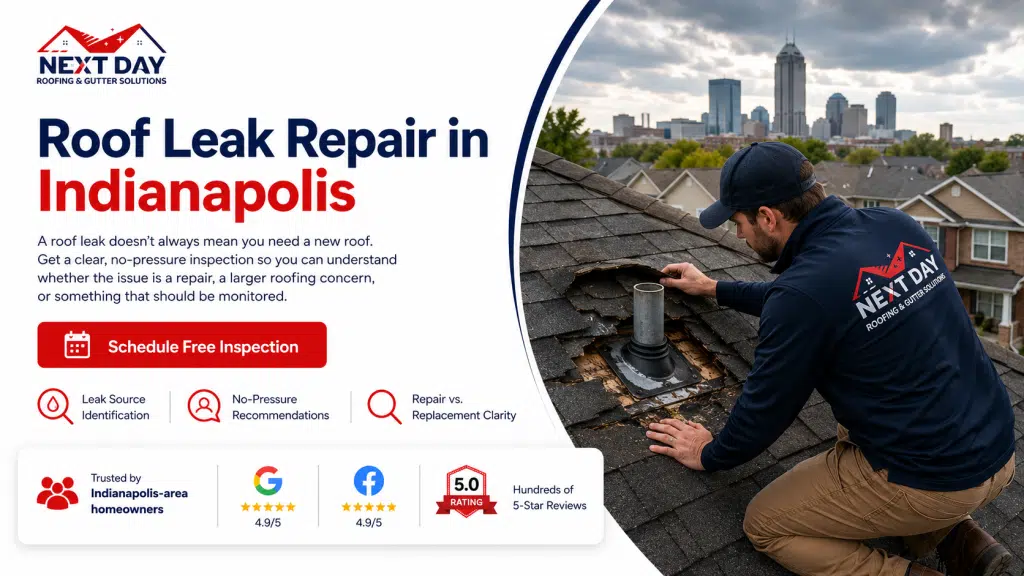
Not Every Roof Leak Requires Full Roof Replacement
Many homeowners hesitate to call a roofing company because they worry the answer will automatically be, “You need a new roof.”
That is not always true.
Some roof leaks come from isolated issues that can be repaired, such as damaged flashing, missing shingles, worn pipe boots, exposed nail heads, or a small storm-damaged section. Other leaks may point to a larger problem, especially if the roof is older, has widespread shingle damage, or has multiple leak points.
Our job is to help you understand the difference.
During a roof leak inspection, we look for:
- Where water may be entering
- Whether the leak is isolated or widespread
- Whether shingles are missing, lifted, cracked, or worn
- Whether flashing is loose, rusted, or improperly sealed
- Whether pipe boots, vents, skylights, or chimneys are vulnerable
- Whether gutters or drainage issues are contributing to the problem
- Whether storm damage, age, or installation issues may be involved
- Whether the roof still has repairable life left
Then we explain your options in plain language.
Common Signs You May Have a Roof Leak
Roof leaks do not always appear as active dripping water. Sometimes the signs are subtle at first.
You may need a roof leak inspection if you notice:
- A brown or yellow stain on the ceiling
- Water spots near walls or corners
- Dripping during heavy rain
- Damp insulation in the attic
- Musty smells after storms
- Peeling paint or bubbling drywall
- Stains around vents, chimneys, or skylights
- Light coming through the attic roof decking
- Missing shingles after wind
- Granules collecting in gutters
- Water marks that appear and disappear depending on the rain
Even a small ceiling stain should be taken seriously. Water can travel before it becomes visible inside the home, which means the source of the leak may not be directly above the stain.
What Causes Roof Leaks in Indianapolis Homes?
Indianapolis roofs deal with wind, hail, heavy rain, temperature swings, aging shingles, and seasonal debris. Over time, small vulnerabilities can turn into leaks.
Common causes of roof leaks include:
Missing or Damaged Shingles
Wind can lift, crease, or remove shingles. Once the protective surface is compromised, water can reach the underlayment or roof decking.
Lifted Shingles
A shingle does not have to be completely missing to cause a problem. If the seal is broken, wind-driven rain can get underneath it.
Damaged Flashing
Flashing protects areas where the roof meets walls, chimneys, valleys, skylights, and other transitions. Loose or damaged flashing is one of the most common sources of roof leaks.
Worn Pipe Boots
Rubber pipe boots can crack, split, or deteriorate over time. When that happens, water can enter around plumbing vent pipes.
Chimney or Skylight Leaks
Chimneys and skylights have multiple seams and transition points. If flashing or sealant fails, leaks can appear around those areas.
Clogged or Damaged Gutters
When gutters cannot move water away properly, water may back up near the roof edge, fascia, soffit, or foundation. Sometimes what looks like a roof leak is actually a drainage issue.
Hail or Storm Damage
Hail can bruise shingles and knock away protective granules. Wind can loosen shingles and roof components. The damage may not leak immediately, but it can weaken the roof over time.
Aging Roof Materials
As shingles age, they lose flexibility and protective granules. Older roofs are more likely to develop leaks, especially after storms or freeze-thaw cycles.
Can a Roof Leak Be Repaired?
Yes, many roof leaks can be repaired.
A repair may be possible when the leak is limited to one area and the surrounding roof is still in reasonable condition. Common roof leak repairs may include:
- Replacing missing shingles
- Securing lifted shingles
- Repairing or replacing flashing
- Replacing cracked pipe boots
- Sealing vulnerable roof penetrations
- Repairing small storm-damaged sections
- Addressing exposed nail heads
- Correcting localized gutter or drainage issues
The key is identifying the actual source of the leak before recommending a solution.
A ceiling stain tells you water made it inside. It does not always tell you where the water entered.
When a Roof Leak May Point to a Bigger Problem
Some leaks are isolated. Others are symptoms of a roof that is nearing the end of its useful life.
Replacement may need to be discussed if:
- The roof has multiple leak points
- Shingles are brittle, curling, or deteriorating
- Large sections of shingles are missing or damaged
- There is widespread granule loss
- The roof has repeated repairs in the same areas
- Decking appears soft or damaged
- Storm damage is widespread
- The roof is older and no longer protecting the home reliably
If replacement is worth considering, we will explain why. If repair makes more sense, we will say that too.
Roof Leak Repair vs. Roof Replacement
The right solution depends on the condition of the whole roof, not just the leak you can see.
A roof repair may make sense if:
- The roof is generally in good condition
- The leak source is clear and isolated
- The damage is limited to one area
- The surrounding shingles still have useful life
- The repair would provide good value
A roof replacement may make sense if:
- The roof is near the end of its life
- Damage is widespread
- Repairs would only delay a larger issue
- Leaks keep coming back
- Storm damage affects multiple slopes
- The cost of repeated repairs no longer makes sense
Our goal is to help you make a confident decision, not push you toward the most expensive option.
No-Pressure Roof Leak Inspections in Indianapolis
A roof leak is stressful enough. You should not have to worry that asking for help will turn into a high-pressure sales pitch.
Our roof leak inspection process is built around clarity.
We help you understand:
- Where the leak may be coming from
- Whether the issue appears urgent
- Whether the problem looks repairable
- Whether storm damage may be involved
- Whether replacement should be considered
- What could happen if the leak is ignored
- What your practical next steps are
You get a straightforward explanation before making a decision.
Why You Should Not Ignore a Small Roof Leak
A small leak can turn into a larger problem if water continues to enter the home.
Over time, roof leaks can lead to:
- Damaged insulation
- Stained ceilings
- Mold or mildew concerns
- Soft or weakened roof decking
- Damaged drywall
- Electrical concerns
- Rot around fascia, soffit, or framing
- Higher repair costs later
You do not need to panic over a small stain, but you should find out what caused it.
A simple inspection can help you understand whether the issue is minor, repairable, storm-related, or a sign of a larger roofing concern.
Indianapolis Areas We Serve
Next Day Roofing & Gutter Solutions provides roof leak inspections and roof repair services throughout the Indianapolis area, including:
- Indianapolis
- Carmel
- Fishers
- Noblesville
- Westfield
- Zionsville
- Avon
- Brownsburg
- Plainfield
- Greenwood
- Lawrence
- McCordsville
- Greenfield
- Beech Grove
- Speedway
- Franklin Township
- Geist-area neighborhoods
If you are seeing signs of a leak after heavy rain, wind, hail, or normal roof wear, we can inspect the roof and help you understand what is happening.
Why Indianapolis Homeowners Call Next Day Roofing & Gutter Solutions for Roof Leaks
Homeowners call us when they want clear answers before making an expensive decision.
They may not know whether the leak is minor or serious. They may not know whether the issue came from storm damage, age, flashing, gutters, or a failing roof system. They may simply want to know whether the roof can be repaired.
That is exactly where we help.
With Next Day Roofing & Gutter Solutions, you get:
- A free roof inspection
- Clear explanations
- No-pressure recommendations
- Repair and replacement options when appropriate
- Help identifying leak sources
- Photos and documentation when needed
- Roofing and gutter solutions for the full exterior system
We focus on helping you understand the roof before you decide what to do next.
Schedule Roof Leak Repair in Indianapolis
If you have a roof leak, ceiling stain, missing shingles, or water showing up after heavy rain, it is better to inspect the roof before the issue spreads.
Your roof may only need a repair. Or it may need a larger solution. Either way, you deserve a clear explanation before making a costly decision.
Schedule your free roof leak inspection with Next Day Roofing & Gutter Solutions today.
Frequently Asked Questions About Roof Leak Repair in Indianapolis
Does a roof leak mean I need a new roof?
No. A roof leak does not always mean you need full roof replacement. Many leaks come from isolated issues like missing shingles, damaged flashing, cracked pipe boots, or small storm-damaged sections. A roof inspection can help determine whether repair or replacement makes more sense.
Can a leaking roof be repaired?
Yes, many leaking roofs can be repaired if the damage is limited and the surrounding roof is still in good condition. The repair may involve replacing shingles, fixing flashing, sealing a roof penetration, replacing a pipe boot, or correcting a drainage issue.
How urgent is a small roof leak?
A small roof leak should be inspected soon. It may not require emergency replacement, but water can spread into insulation, decking, drywall, and framing if the source is not addressed.
Why does my roof only leak during heavy rain?
A roof that only leaks during heavy rain may have an issue with wind-driven rain, flashing, valleys, roof penetrations, gutters, or a vulnerable area that only fails under heavier water flow. The leak source may not be obvious without an inspection.
Can wind damage cause a roof leak?
Yes. Wind can lift shingles, break seals, expose nail heads, damage ridge caps, or remove shingles completely. Even if the roof looks mostly normal from the ground, wind damage can create openings for water.
Can hail damage cause a roof leak?
Yes. Hail can bruise shingles, loosen granules, damage vents, and weaken roof materials. Hail damage may not cause an immediate leak, but it can reduce the roof’s ability to shed water over time.
What are the most common roof leak locations?
Common leak locations include chimneys, skylights, roof valleys, pipe boots, vents, flashing, ridge caps, gutters, and areas where shingles are missing or damaged.
How do I know if the leak is from the roof or gutters?
Water near the ceiling or attic often points to the roof, while overflow near the roof edge, fascia, soffit, or foundation may involve gutters. However, roof and gutter issues can overlap, so it helps to inspect the full exterior water-shedding system.
Should I call insurance for a roof leak?
It depends on the cause of the leak, your deductible, and your policy. If the leak appears related to storm damage, documentation may be helpful. A roof inspection can help you understand whether there is visible damage before you decide whether to contact your insurance company.
Do you offer no-pressure roof leak inspections?
Yes. Our goal is to explain what we find and help you understand your options. If a repair makes sense, we will tell you. If replacement should be considered, we will explain why. If the roof appears okay, we will say that too.